


Once a product strictly reserved for the prosperous, whereas at all times a barometer of aspiration, the iPhone neatly sums up India’s consumption story in 2024. Apple bought iPhones value $10.7 billion or ₹90,680 crore in India within the first 9 months of the yr, with the September quarter (Q2FY25) logging the largest-ever quarterly cargo at 4 million models, in line with the International Data Corporation, a market analysis agency.
The iPhone exemplifies India’s post-covid consumption story which begins with a Okay—all caps and daring. The prosperous and the higher center class got here out of the pandemic with an untameable demand for luxurious and aspirational items and providers whereas the decrease strata, nonetheless preventing inflation, have strictly stored spending restricted to requirements.
“Consumption in 2024 and most certainly in 2025 can be a story of components,” Trideep Bhattacharya, president and chief investment officer (CIO) of equities at Edelweiss Mutual Fund told Mint. “We started the year strongly with robust luxury consumption and it stayed intact throughout the year. While urban (mass) consumption was a major laggard this year, rural consumption will kick in sometime in 2025.”
View Full Image
Such juxtaposing themes solidified the Indian inventory market’s narrative in 2024, beneath all of the froth and hype. The Nifty Realty index and the Nifty India Consumption index have been two of the highest performing sectors of 2024, returning 35% and 34% respectively. These two sectors have been the most important beneficiaries of “premiumization”, the place sturdy demand for premium properties, SUVs, luxurious motels, jewelry and digital durables boosted the profitability and therefore, earnings of many firms, all towards the chances of a sticky inflation and negligible actual wage development.
However, these challenges outlined the opposite half of India’s consumption narrative. Languishing gross sales volumes and suppressed revenue margins of main fast-moving client items firms (FMCG) and quick-service restaurant chain operators mirrored a slowdown within the consumption of the lower-middle class.
In reality, the Nifty FMCG index was one of many worst performers, falling virtually 1percentduring a bull run within the broader market. With demand woes reportedly persevering with throughout the normally supportive festive season and anticipated to spill over into the brand new yr, FY25 can be a yr FMCG firms want to swipe below the rug.
During such testing instances, buyers are betting on well-established tendencies like premiumization to maintain the momentum in 2025–particularly in the true property sector.

Luxury residing
The post-covid actual property growth has been the hallmark of a roaring consumption-comeback story. As India’s actual property sector efficiently completed its fourth yr of a growth cycle, bouts of gross sales pickup and accelerated venture launches have pushed up property costs throughout all seven main metros in recent times. No marvel, shares of main listed actual property builders like Sobha Ltd, Oberoi Realty Ltd and Godrej Properties Ltd have returned 63%, 59% and 38% respectively, by the top of 2024.
With dwelling gross sales growing by 49% between 2022 and 2024, the common worth per sq. ft has risen by round 41% since 2021, in line with Anarock Property Consultants. Among the highest markets, National Capital Region (NCR), Bengaluru, and Hyderabad have seen the most important improve in costs, owing to an explosion in demand for high-ticket properties. Moreover, tepid reasonably priced housing demand has prompted actual property builders to deal with the burgeoning luxurious and premium phase, aiding the sector’s pricing trajectory even throughout a comparatively slower first half in FY25.
“The premiumization development in housing is clear from the truth that Q2FY25 gross sales volumes for high 17 builders have been down 12% year-on-year (y-o-y) whereas gross sales worth was up 1% y-o-y. Average gross sales realizations for this set of builders have been up 15% y-o-y in Q2FY25,” a Nuvama Institutional Equities report from 27 November said.

The first half of FY25 was marked by muted launches attributable to approval-related points. With state elections in Maharashtra and Haryana out of the way in which, consultants are anticipating sooner approval for newer initiatives in key residential markets like Gurugram, Mumbai Metropolitan Region and Pune.
Even although listed builders have exhausted their inventories, demand for luxurious properties stays unsatiated. Hence, these gamers may have extra pricing energy and higher realization good points for his or her newer properties. But on the similar time, low stock has made new launches a differentiating issue for listed actual property shares since it’s essential for sustaining pre-sales volumes.
However, after a staggering 18% and 31% compound annual development during the last 4 years, pre-sales quantity and worth may be impacted in 2025 because of the statistical impact of an already excessive base, in line with a HSBC Global Research report dated 11 December.
With dwelling gross sales growing by 49% between 2022 and 2024, the common worth per sq. ft has risen by round 41% since 2021.
Meanwhile, buyers can take consolation from the actual fact luxurious demand remains to be intact and listed realty firms have quite a lot of headroom for enterprise growth and new land offers, because of their strong money flows. Most of them have utilized an excellent chunk of their working money flows and round 34% of their collections on land associated capital expenditure, lowering their debt burdens, the Nuvama report famous.
“We stay constructive on the sector in the long term with a desire for gamers with a robust launch pipeline and strong stability sheets,” Pankaj Kumar, vice president of fundamental research at Kotak Securities told Mint. “An interest rate cut next year would likely lead to further re-rating of players, particularly in the mid-affordable segment.”
Lower rates of interest would imply cheaper dwelling loans which can enhance affordability and therefore demand for homes, significantly within the mid-affordable phase.
The P-word
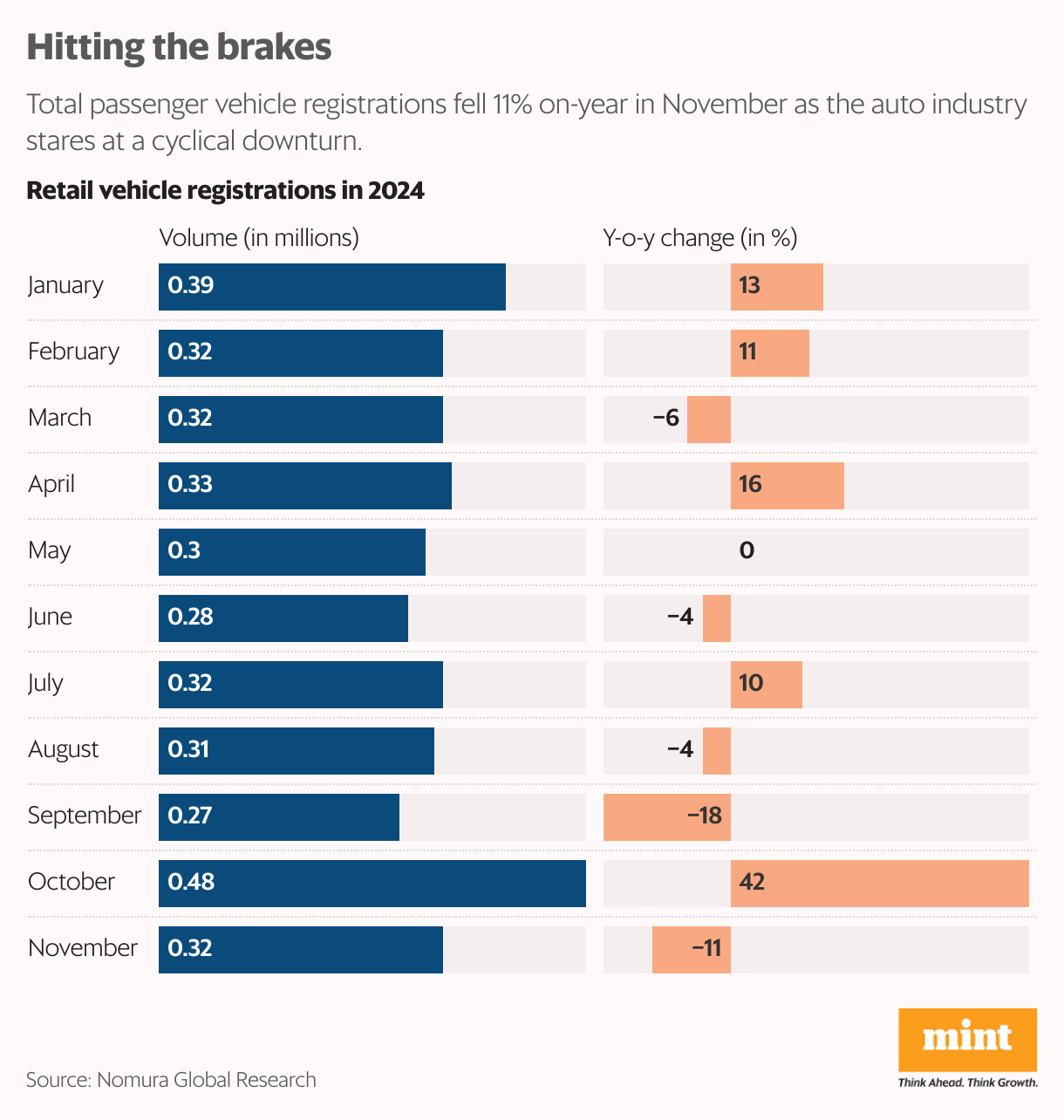
High inflation coupled with elevated rates of interest and tighter credit score situations curtailed the aspirations of many middle-class Indians in 2024—a phenomenon mirrored in languishing entry-level passenger automobile gross sales all year long.
While two-wheeler demand remained wholesome, first-time consumers moved to India’s booming second-hand automotive market. Those who might afford flocked to the saturating sports activities utility automobile (SUV) market as mirrored in Mahindra and Mahindra Ltd’s strong Thar and XUV3XO gross sales volumes in Q2. As a consequence, the share worth of M&M climbed 74% by the top of 2024.
But not simply automobiles or homes, prosperous Indians are additionally keen to a pay premium for brand spanking new and distinctive experiences, which sustained the continuing growth in India’s luxurious tourism this yr. Investors have been betting huge on premium lodge firms ever for the reason that post-covid growth in tourism coincided with an increase in luxurious spending within the nation within the final couple of years.
Shares of Indian Hotels Co Ltd (manufacturers embrace Taj) and EIH Ltd (the Oberoi Group) have risen 99% and 67% by the top of 2024, and with tourism demand anticipated to outstrip the provision of recent lodge rooms within the close to time period, consultants see the upcycle within the business to proceed for the subsequent three-four years.
Brands like Taj and Oberoi noticed a 9-10% on-year rise of their common room charges (ARR) in Q2FY25, whereas occupancy ranges remained excessive at round 72-78%. Even Lemon Tree Hotels Ltd benefitted from the continuing premiumization within the mid-market phase, which boosted its consolidated ARR by 12% y-o-y, regardless of its comparatively decrease occupancy charges.
A unique story of aspiration performed out within the digital durables sector the place a very harsh summer time boosted the gross sales of air conditioners (AC), leading to a bumper H1 for Blue Star Ltd and Voltas Ltd. While Blue Star noticed a pickup in its extra worthwhile business air-con enterprise, Voltas noticed a forty five% on-year rise in AC gross sales within the first half.
“ACs have develop into an ordinary function for even reasonably priced homes, because the proportion of AC value to the price of the house is kind of low. Since it’s a primary aspiration the entire household advantages from, AC gross sales will proceed to develop even throughout common summers,” Deepak Jasani, head of analysis at HDFC Securities advised Mint.
ACs have develop into an ordinary function for reasonably priced homes, because the proportion of AC value to the price of the house is kind of low.
—Deepak Jasani
Both Blue Star and Voltas supplied spectacular 128% and 84% returns in 2024, respectively. However, a lot of their present valuations, together with that of Dixon Technologies (India) Ltd are backed by the promise of an upswing in India’s electronics manufacturing sector subsequent yr.
But Tata Group-owned Trent Ltd wrote essentially the most defying consumption story of 2024, with the inventory returning a whopping 129% all year long. The trend and life-style retailer bucked the present development of mass-market consumption slowdown with Zudio’s reasonably priced but stylish portfolio of merchandise, posting a 44% on-year rise in internet earnings at ₹338 crore in Q2.
“Zudio has been significantly common with the Gen-Z, and traditionally we have now seen that manufacturers which as soon as resonate effectively with customers are likely to do higher even throughout a broadly gradual macroeconomic surroundings,” Bhattacharya famous.
Going ahead, Nuvama expects a robust Q3 for retail firms owing to a fabric pickup in festive demand for garments and jewelry in October—a momentum they anticipate to proceed by way of the marriage season this yr.
A defensive play
While buyers guess boldly on India’s consumption story, bouts of exterior volatility additionally drove them in the direction of extra defensive sectors like healthcare and prescription drugs, crowning them because the best-performing sectors of 2024. The Nifty Healthcare index outperformed each different sector with a 40% return, whereas the Nifty Pharma index posted a strong 38% return final yr.
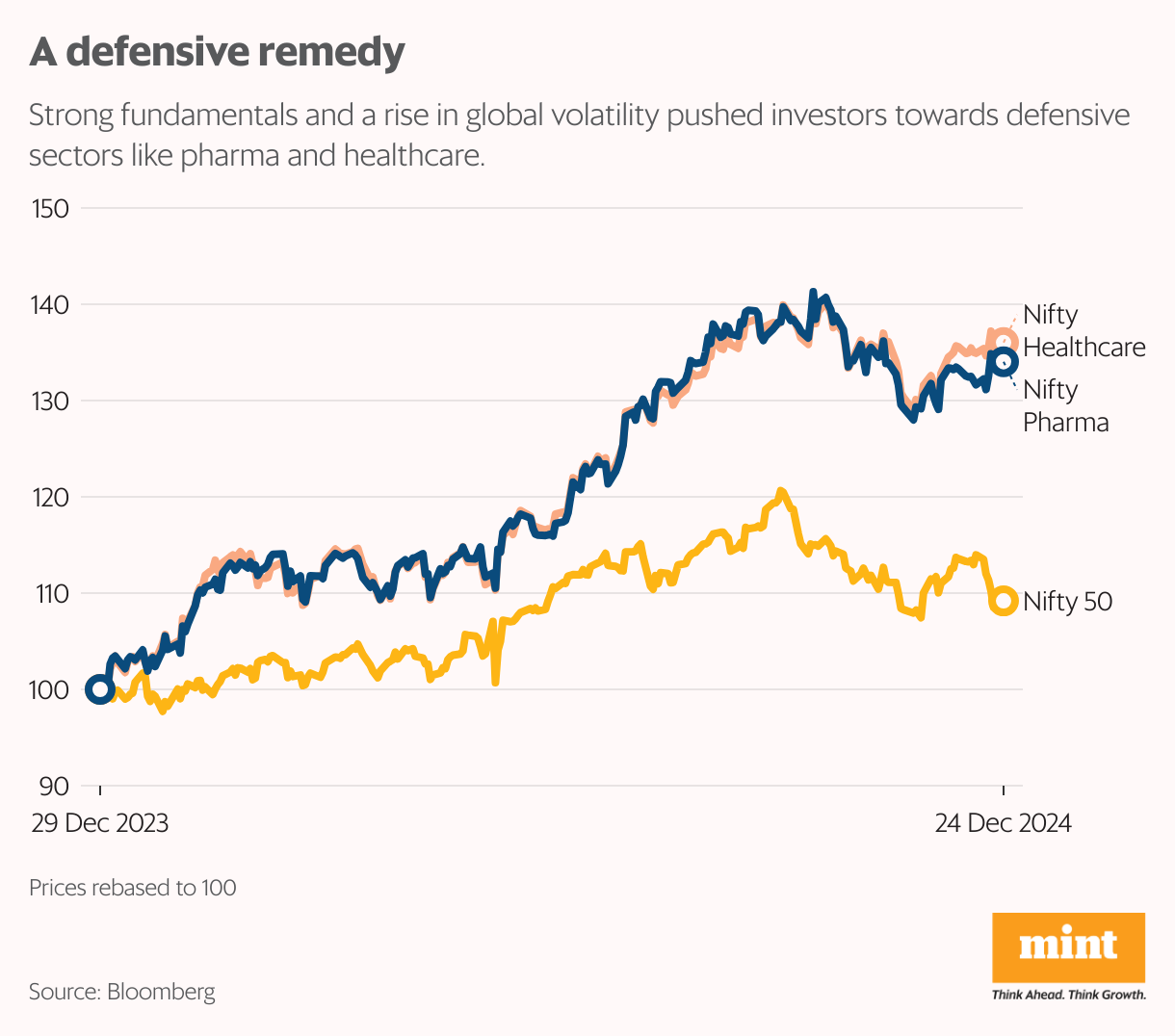
Shares of main pharma firms like Sun Pharmaceutical Industries Ltd, Glenmark Pharmaceuticals Ltd and Mankind Pharma rose 51%, 89% and 45% respectively in 2024 whereas these of Max Healthcare Institute Ltd, Fortis Healthcare Ltd and Artemis Medicare Services Ltd rose 66%, 63% and 80% respectively.
An uptick in insurance coverage penetration post-covid has led to increased footfalls in main hospitals, which coupled with a rising demand for advanced remedies in oncology and cardiology has supplied strong development visibility to buyers.
“Most hospitals’ networks are mature now. So, they’re worthwhile and generate quite a lot of money. These firms have been already doing effectively, they usually continued beating expectations this yr,” Prashant Nair, lead pharma and healthcare analyst at Ambit Capital advised Mint.
On the opposite hand, Indian pharma firms noticed improved profitability in Q2 from increased gross sales of branded medicines within the home market, falling energetic pharmaceutical elements (API) prices and cheaper price erosion within the US generic market. Sun Pharma noticed strong demand for its prescribed branded medicines, resulting in 11% on-year development in its home enterprise regardless of its giant dimension. Whereas Dr. Reddy’s home enterprise grew 10% on-year in Q2, pushed by three new model launches within the quarter.
Most hospitals’ networks are mature now. So, they’re worthwhile and generate quite a lot of money.
—Prashant Nair
As per IQVIA Institute, the Indian pharma market grew 10.7% y-o-y in November, primarily pushed by sturdy traction throughout all acute and power therapies. “On a low base of FY24, we imagine higher traction in acute therapies could proceed to drive home market development for the subsequent couple of months,” an ICICI Securities report from 11 December stated.
With earnings from generic Revlimid gross sales within the US anticipated to peak out in the midst of 2025, analysts assume pharma firms are effectively positioned as they enter the brand new yr. “Since the underlying companies are doing nice, the defensive attraction of this sector additionally labored in its favour as we got here in the direction of the top of the yr,” Nair said. “They did well in the face of market volatility and are likely to do so going forward.”
The yr forward
If 2024 was the yr of aspiration and luxurious consumption, market individuals are anticipating a rebound in broad-based consumption in 2025, as they anticipate elevated largesse from the federal government for the poor subsequent yr.
“The ‘Ladki Bahin Yojana’ (month-to-month stipends of ₹1,500 to ladies dealing with monetary hardship) was a recreation changer for the ruling celebration within the current Maharashtra meeting election. This signifies an upcoming shift within the financial regime as a result of such schemes have develop into the success mantra in Indian politics,” Neeraj Chadawar, head of fundamental and quantitative research at Axis Securities told Mint. “We believe broad-based consumption could be back in 2025, led by the expectation of higher rural demand in FY26 as compared to FY25.”
While consumption stays a vital driver of financial development, consultants are betting on India’s digital manufacturing, IT, and the capital items sector to be in favour subsequent yr.
