


The enduring silver lining in India’s exports image, although, has actually been on the providers aspect. In August, providers exports grew about 7% in year-on-year phrases to $30.7 billion. For the primary 5 months of this monetary 12 months, they grew round 11%. On present traits, it’s potential that providers exports will exceed items exports (which have been at $34.7 billion in August) sooner or later in month-to-month phrases, at the very least quickly.
If this occurs, it is going to be the excessive level of a shift that’s been twenty years within the making. Ten years in the past, India’s providers exports amounted to not more than a 3rd of its whole exports. This July, providers exports have been 47% of the whole. According to a examine by the central financial institution, since 1993, providers exports have grown at an annual common fee of 14%, in contrast with round 10.7% for items exports.
India is now the seventh largest providers exporter on the earth. In 2001, it was the twenty fourth largest. In distinction, the nation’s report in items exports has been extra blended. In 2005, India accounted for round 1% of the world’s items exports. In 2023, it had risen, however was nonetheless lower than 2%. Over the identical interval, India’s share of world providers exports rose from 1.9% to round 4.6%. Goldman Sachs expects India’s providers exports to be round $800 billion by 2030, up from $337 billion in 2023, amounting to 11% of India’s GDP.
India is now the seventh largest providers exporter on the earth. In 2001, it was the twenty fourth largest. In distinction, the nation’s report in items exports has been extra blended.
A joint World Bank-World Trade Organization report factors out that the share of the service sector in international GDP rose from 53% in 1970 to 67% in 2021. If India missed the bus on the increase in international items commerce, it’s fortunate sufficient to have gotten a second likelihood with the increase in providers commerce, and has been in a position to revenue off that to a a lot higher extent.
Given the optimism surrounding each present traits in providers exports, and the chance that such traits will persist sooner or later, what impact will the transformation in India’s export basket have on the home economic system?
Structural components
Even past the numbers and the expansion, providers exports have benefits. India runs a surplus in providers commerce, of $13-14 billion a month. This helps cut back strain on the present account deficit, which is created by advantage of India importing extra items than it exports.
This deficit has all the time existed. While it’s typically attributed to the necessity for India to import a big chunk of its petroleum necessities, it’s price mentioning that even after excluding gadgets like petroleum and gems and jewelry from the imports basket, imports nonetheless exceed exports by a considerable margin.
View Full Image
In the quick time period at the very least, it will probably proceed as a result of producers working beneath the production-linked incentive (PLI) scheme of the federal government, supposed to advertise home manufacturing, will nonetheless have to import enter parts from abroad. “Robust progress and stability in providers exports have imparted power to India’s stability of funds (BoP) by offsetting a big a part of the economic system’s merchandise commerce deficit,” factors out a analysis paper by the Reserve Bank of India on providers exports.
The different issue is how providers exports reply to shifts in international demand. Exports basically are extremely delicate to the state of the worldwide economic system, particularly demand circumstances prevailing in richer economies.
Estimates final 12 months by the chief financial advisor to the finance ministry discovered {that a} one share level enhance in international GDP results in an increase of 4.92 share factors within the general demand for India’s exports. This upside appears nice, but additionally has a draw back. A world financial disaster inflicting a fall in international GDP can result in a disproportionately massive drop in Indian exports.
Interestingly, because the RBI present in its examine, this ‘income elasticity’ is far decrease for providers exports: round 2.5. In different phrases, a one share level rise or fall in international GDP results in a 2.5 share level rise or fall in Indian providers exports (after adjusting for value modifications). In different phrases, providers exports reply comparatively weakly to will increase in international GDP in comparison with items exports, but additionally appear much less weak to sharp downturns within the international economic system.
This was very a lot in proof in the course of the onset of the covid-19 disaster and international lockdowns in early-2020, which prompted a collapse in items exports. In distinction, the decline in providers exports was nowhere close to as a lot. Since a big proportion of providers exports are delivered digitally, they’re much less liable to disruption than items exports, that are extra depending on the vagaries of world logistics, particularly at a time when geopolitical tensions can choke international industrial transport.
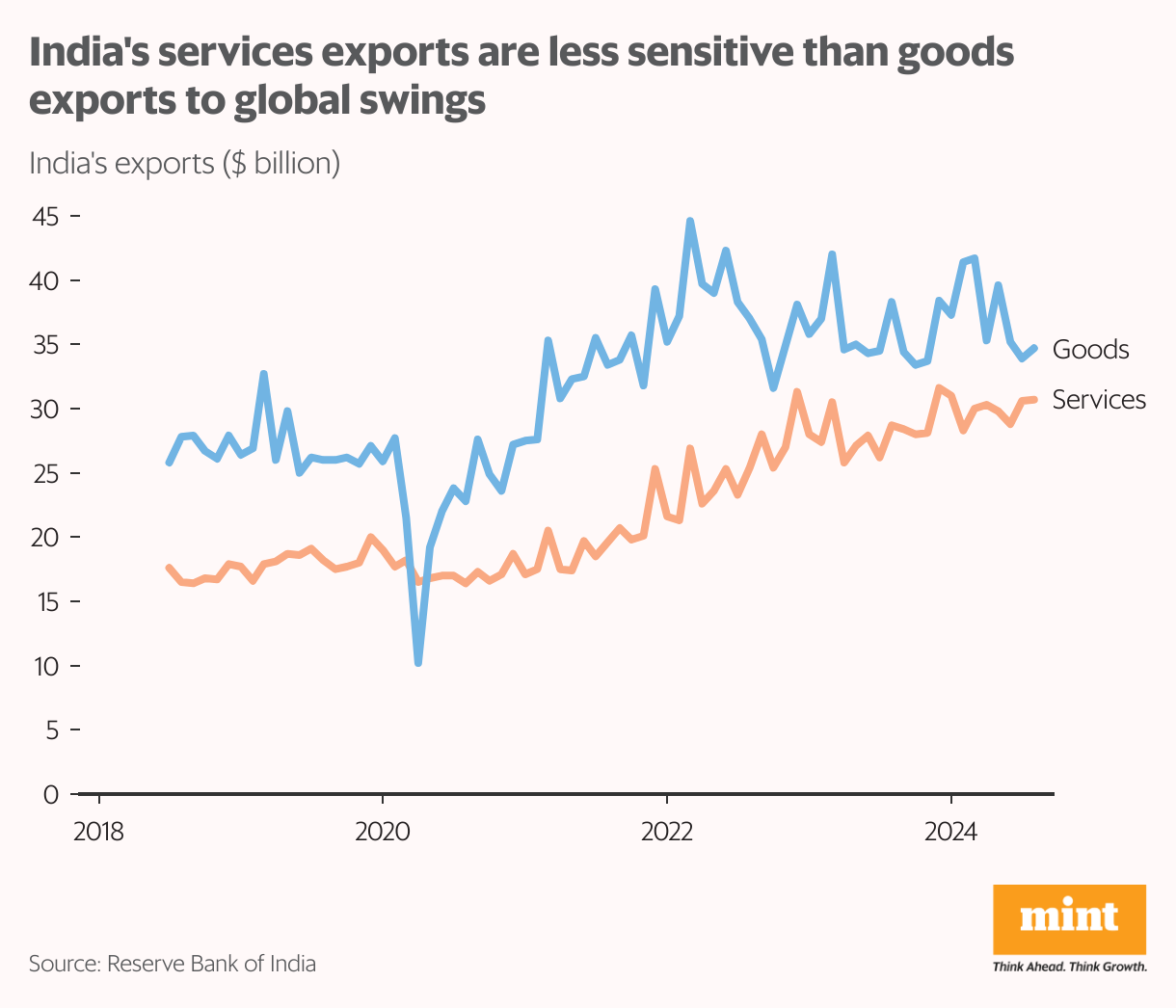
Further, factors out the RBI examine: “Services, particularly fashionable providers, use fewer imported inputs, have decrease fastened prices of entry and are in extremely aggressive sectors which permit for an elastic provide response [in response to a reduction in the price].” And the shift to distant work, because the RBI examine factors out, has been a boon for digitally-delivered providers work, rising 37% between 2019 and 2022.
Beyond the again workplace
As the Goldman Sachs examine factors out, “When India’s providers exports initially started to develop, it was on the again of ‘offshoring’: a cost-saving measure wherein international corporations outsourced their back-office operations to models in India.”

View Full Image
They have developed to one thing extra. Now referred to as international functionality centres (GCCs), such again places of work have turn out to be extra specialised, says the examine, and presently make use of round 1.7 million staff. The variety of such GCCs has risen from 700 to 1,580 during the last 13 years and accounted for $46 billion price of income in 2023.
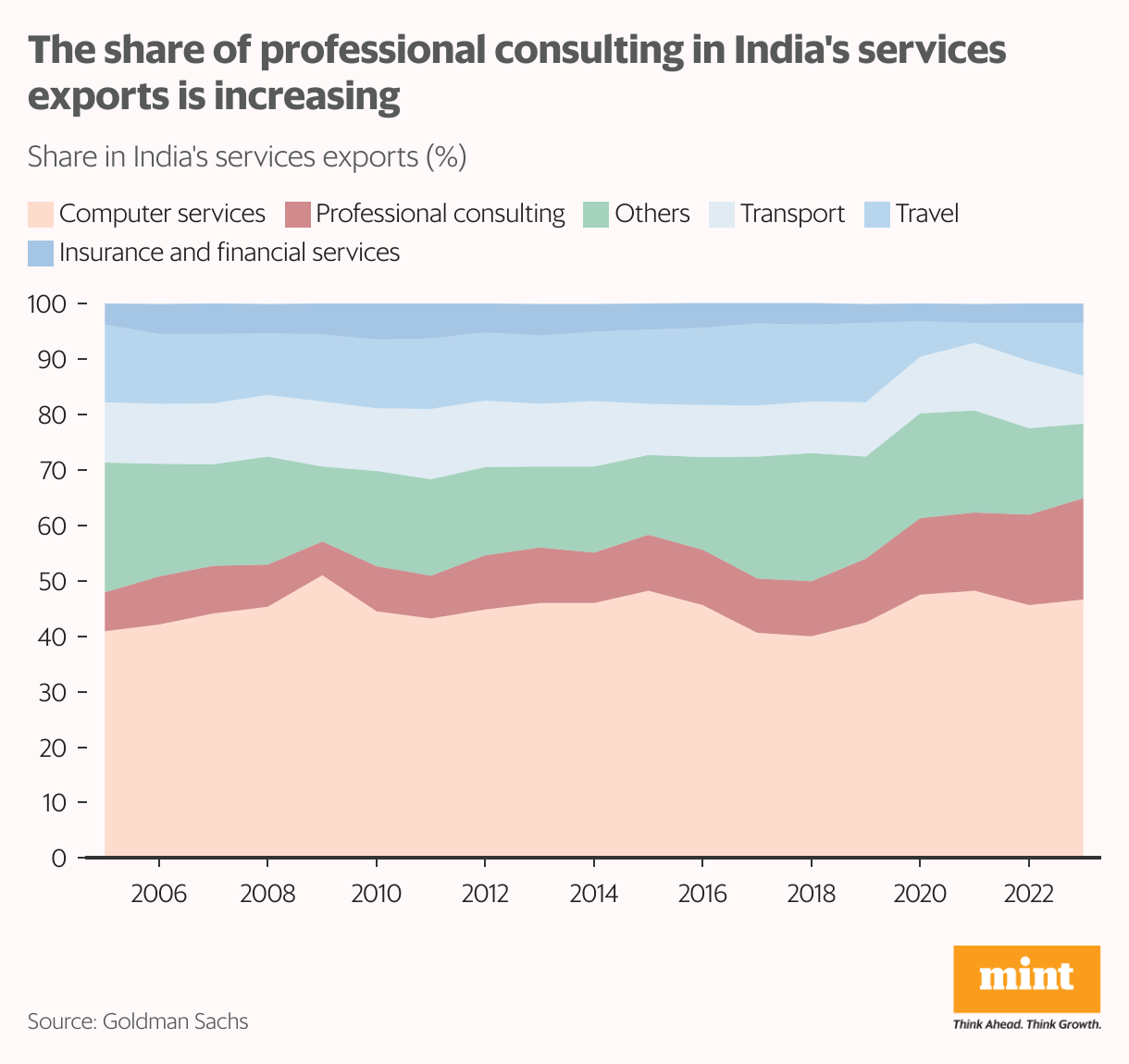
Both again workplace and IT providers (and the overlap between them) then appear to encapsulate the India service export success. And, going by the numbers, this doesn’t appear to have modified a lot. As the chart, on the share {of professional} consulting in India’s providers exports, exhibits, pc providers have been, and stay, the dominant software program export, at round 47% of whole service exports.
This, actually, grew to become a matter of concern to many analysts, who identified that such cost-saving providers have been extremely price-sensitive. As the Indian workforce aged and salaries rose, they may simply be outbid by related companies in different nations, on price phrases alone, inflicting the again workplace to shift elsewhere.
And, as identified earlier, whereas providers exports appear much less weak to financial downturns, they’re removed from immune. How price-sensitive, and the way delicate to the worldwide financial context, the IT providers market is has been laid naked during the last 12 months. There have been vital layoffs throughout the IT sector. In 2023-24, in keeping with a Mint report, the three massive IT majors—TCS, Wipro and Infosys—collectively laid off about 64,000 staff.
But the background shift inside providers exports is a transfer up the worth chain, which is arguably much less delicate to speedy value shifts. The share {of professional} consulting providers in India’s service exports has elevated from 7% in 2005 to 18.3% in 2023. As the report by the CEA factors out: “While the early 2000s was a interval of BPOs mushrooming to offer cost-cutting back-end IT providers, India now seems to be past simply cost-cutting … India has gone from offering back-end providers in regulation, IT, and administration in 2010 to offering upstream, high-value-added providers in these areas by 2020.”
Domestic impression
For a long time, the expansion of providers was regarded lower than favourably by economists and policymakers. “Many providers have lengthy been portrayed as non-tradable actions characterised by low productiveness and wages, responding primarily to home demand and providing much less fascinating progress and improvement paths relative to manufacturing,” pointed out the World Bank-WTO study. “The economic development gains associated with the export-oriented, manufacturing-led development in East Asia reinforced the belief that the pathway to sustained growth for lower-income economies necessarily lay with manufacturing.”

View Full Image
However, because the examine identified, the providers sector at the moment generates extra jobs (50% share of employment worldwide) and output (67% share of world GDP) than agriculture and business mixed.
But how will the rising significance of providers commerce form the Indian economic system? “We count on the expansion in high-value providers to domestically drive top-end discretionary consumption, and industrial and residential actual property demand,” says Santanu Sengupta within the Goldman Sachs analysis report.
One downside with the rising significance of providers exports is how locationally concentrated they’re. Large cities or city centres reminiscent of Bengaluru, Hyderabad and Gurugram dominate employment in providers exports, despite the fact that a few of that is starting to vary, with corporations extra keen to make use of employees in smaller cities and cities.
The different, greater downside although is with the way it may reinforce, fairly than counter traits already seen within the broader economic system.
The massive problem for the Indian economic system since at the very least the 2008 international monetary disaster has been jobs. Since 2011-12, GDP progress has merely not generated the identical quantity of jobs that it did earlier. According to World Bank information, direct and oblique employment created by exports fell to 13% of home employment in 2020, from 19% in 2012. “This is as a result of India’s exports have more and more consisted of skill-intensive manufacturing and providers,” says the World Bank. “Because these sectors are highly capital-intensive, they are ill-suited to employ large shares of the Indian workforce.”
One downside with the rising significance of providers exports is how locationally concentrated they’re. Large cities or city centres reminiscent of Bengaluru, Hyderabad and Gurugram dominate employment in providers exports.
The providers sectors wherein India has had essentially the most success in producing exports—IT providers, enterprise consulting and so on—are additionally the identical sectors that overwhelmingly make use of a way more expert workforce, which is concentrated in massive city areas. More importantly, this additionally applies to massive organizations within the ‘formal’ sector, as a result of that is the place scale makes the availability of such providers extra environment friendly. So, on this respect at the very least, each providers and manufacturing exports are related.
On the one hand, this gives grounds for optimism. Assuming providers exports develop at a quick sufficient tempo sooner or later, we will hope that the demand for expert employment will generate the availability wanted. While the 14%-plus annual progress in providers exports over the previous couple of a long time has actually raised employment within the related sectors by tons of of hundreds of employees, it has not made a significant dent on employment ranges within the economic system as a complete. The absolute dimension of providers exports must be bigger by many multiples to have the ability to achieve this.
Will providers exports proceed to develop on the similar fee? As identified earlier, providers now account for 67% of world GDP. While they may develop additional, it’s more likely that the demand for cross-border providers will monitor progress in international GDP in future years, fairly than exceed it, as has been the case.
The substantial progress in providers exports over the previous couple of a long time has been a internet constructive for the Indian economic system. But will this progress do for the Indian economic system what manufacturing exports have to date did not do, and what such exports did for East Asia? That is unlikely.
howindialives.com is a search engine for public information
